|
|
Huntingtown Volunteer Featured in Readers Digest: One-In-A-Million Rescue |
| By Chief Jonathan Riffe | |
| January 25, 2009 | |
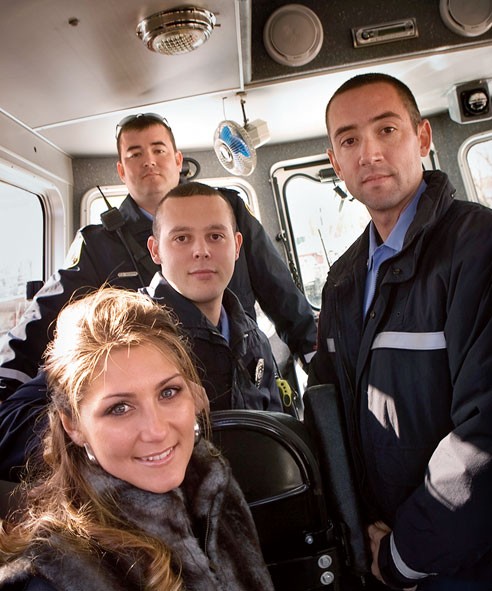
| A woman continues to credit her life due to the quick actions of Huntingtown VFD Deputy Chief Philip Morris. While working for Annapolis City FD, the evening of Saturday July 7, 2008, a storm whipped through the area leading to a dramatic rescue in the bay. A 26-year-old woman was plucked from the waters of the Chesapeake Bay near Gibson Island, after she had been tossed from a sailboat during the storm and had to tread water to survive. Entire article from February 2009 issue of Readers Digest: "Real-life Drama: From Romantic Sail to Night of Terror: How a sudden storm turned one couple's night at sea into a struggle for survival" Aboard her boyfriend's sailboat, Patricia Morgan curled up with a book and started to relax. She and Carlo Fraizzoli had had a hectic week in Baltimore. But now, heading for a scenic cove 25 miles south on the Magothy River, the couple enjoyed the idyllic June evening as they sailed across the Chesapeake Bay, leaving the city's sweltering heat behind them. "I'm glad there's no one out here to hear you," Morgan, 26, teased Fraizzoli, 32, who sat next to the tiller practicing "Twinkle, Twinkle, Little Star" on his harmonica. She glanced up from her book a few minutes later and saw that clouds to the north had darkened the skies over the city. "Did you see that?" she asked as two lightning bolts crackled behind the boat. "Carlo, can we put the motor on and head to shore?" He tried to reassure her, but she persisted: "You don't know how fast these storms come up on the bay!" Within seconds, the sunlit sky above them had turned dark. Whitecaps sprang up on the water, and sheets of rain began to batter the boat. Fraizzoli hurried to release the jib as Morgan jumped up to get a life jacket from the cabin. Before she could grab one, a powerful gust slammed into the boat, tilting the sloop onto its side and sending the mainsail into the water. As the boat tipped, Morgan lost her balance and tumbled onto the rail. Looking facedown into the waves and fearing the boat was capsizing, she made a split-second decision—"I'll be safer in the water" and jumped into the bay. As Morgan floundered in the waves, Fraizzoli righted the boat. "Swim to me!" he yelled to Morgan, throwing her a life preserver. It slipped through her hands as the current began to pull the boat away from her. Fraizzoli started the motor and steered the boat toward the sound of her voice, tossing her the jib line. She missed it, and the motor stalled. Gulping air between the six-foot waves, Morgan watched the powerless boat drift away and out of sight. It was after 9 p.m., and the sea and sky were black. Patricia Morgan was a fighter. Her father left home when she was young. Her mother was a drug addict, leaving Morgan to raise herself and her two younger sisters with the help of her maternal grandmother. She started work as a waitress at 14. By 18, she held two jobs and was renting a townhouse near Baltimore for herself and her sisters. Two years ago, working as a patient service coordinator at a pulmonary clinic, Morgan brought her mother home and helped her through drug rehab and breast cancer treatment. As she struggled in the water, Morgan decided that if she could overcome everything else, she would triumph in this situation too. But she wasn't a strong swimmer and wasn't wearing a life jacket. Don't panic, she told herself. Pace yourself, and don't get water in your lungs. She started swimming toward dim lights on the shore, about two miles away. Then, directly ahead of her, she saw an enormous looming shape: a 200-foot barge, being towed by a tugboat. She'd been pulled into the middle of a shipping channel. The Chesapeake Bay, stretching 200 miles from Virginia Beach into Maryland, is a summer playground for more than 15 million people. It's also a busy commercial waterway where deep-sea freighters, some the length of two football fields, move up and down 24 hours a day. Even in daylight, freighter pilots have trouble slowing down or changing course to avoid obstacles in their paths. At night, the obstacles are impossible to see. From the sailboat, Fraizzoli saw the barge too. It's going to run her over, he thought. I've lost her. Just about everything that could've gone wrong did: The mainsail was in tatters, shredded by the repeated pounding of 60 mph winds. The docking line had fallen off the bow and was now wrapped around the propeller of the outboard motor, jamming it. Fraizzoli had left his ship-to-shore radio, which could have been used to summon rescuers, at home in Baltimore. Helpless and sobbing, he was certain Morgan was dead. A native of Italy, Fraizzoli had loved sailing since he was a boy. With a degree in accounting and commercial law, he came to America in 2006 and got a job with a shipping company. He immediately signed up with a Baltimore-area sailing school, taking lessons once a week for the next year and a half and joining a racing team. Eventually, he bought a 38-year-old sloop, repainted and rewired it, and proudly flew the red-and-yellow Venetian flag on its stern. Fraizzoli cursed himself for forgetting the radio. Suddenly, he remembered Morgan's cell phone and dug for it in her purse. With shaking fingers, he punched in 911. Fraizzoli was unsure of his location, so the dispatcher told him to call back: Rescuers would determine the coordinates of the boat by tracking the cell phone signal. Morgan, meanwhile, swam away from the barge and, astonishingly, got out of its way. After the hulking vessel passed her, she began a frenzied crawl stroke, knowing that in the darkness, another ship could run her down. But the waves kept coming at her. She tried diving underneath them, establishing a ragged rhythm: pop up to the surface and gulp air, swim three or four strokes, then dive again. Halfway across the channel, her arms burned, her legs dragged, and her heart hammered so hard in her chest that she gasped for air. Stopping to tread water, she felt fear gnawing at her. She thought of her sisters. Christina, 18, had come to live with her at age 12. Morgan had made her breakfast, helped her with homework, cheered her on at soccer games, and tucked her in at night. She'd done the same for Megan, now 17. They're too young for me to die, she thought. They need me. On the other side of the channel, Morgan spotted the lighthouse off Gibson Island. Thinking there might be a ladder to hang on to, she headed toward it, alternately paddling and swimming on her back. But when she floated up to it, she almost cried. The iron sides offered no handholds-the ladder was set high above the water to deter vandals. In the distance, she could see lights, brighter now, along the shore. She pushed off and headed for them. Please don't go out, she prayed. At 9:25 p.m., about an hour after Morgan had jumped into the water, the 911 dispatcher notified the Anne Arundel County Fire Department of a woman overboard. The county in turn alerted the Coast Guard, the Maryland Natural Resources Police, and the Annapolis Fire Department. The four agencies prepared to send rescue vessels to Fraizzoli's sailboat, while county fire officials set up a command unit on the ground at nearby Gibson Island to coordinate the search. Greg Young, an Annapolis firefighter, had just finished dinner when the alarm beeped twice. Within ten minutes, he and two other firefighters were motoring out of the harbor on Fireboat 35, a 40-foot cruiser with a sweeper spotlight on the roof. Young, 29, a seven-year fire department veteran and the boat's pilot, was not optimistic. He and the other crew members—Philip Morris and Michael Lonergan—had been out on dozens of man-overboard calls. They knew it would be almost impossible to locate a bobbing head in that vast darkness, especially with a heavy chop on the water. In fact, none of them could remember an overboard call that had resulted in a live rescue. Either they were false alarms or the bodies were found days or weeks later. By 10 p.m., Fireboat 35 and three other rescue boats were nearing Fraizzoli's sloop. A police officer boarded the boat and questioned Fraizzoli, then asked to see Morgan's driver's license. "She's beautiful," the officer said to him. Fraizzoli, who had stayed calm during the interview, broke down. "You're right," he sobbed. Tricia is more than a girlfriend, he thought. She's more like my wife. And now she was gone. Fraizzoli described to the rescue crews the last place he thought he'd seen Morgan. Young began a grid search aboard Fireboat 35. He and his crew assumed Morgan had attempted to swim toward shore, so Young steered the boat slowly back and forth along the two-mile-wide strip of water between the shipping lane and Gibson Island, stopping every few minutes to look and listen. On the rolling deck of the fireboat, Lonergan, 24, and Morris, 29, scanned the waves with a handheld spotlight. A half hour passed. Nothing. The water temperature was a survivable 60-plus degrees, but the relentless pounding of the waves was sure to exhaust even an experienced swimmer. Morgan would have been in the water for nearly two hours by now. "Fireboat 61, can you come in and pick up personnel and equipment?" came a voice on the marine radio. The men knew what that meant: Fire officials were preparing to switch the mission from a rescue to a body retrieval. A side-scan sonar, which allows emergency personnel to search for drowning victims in deep water, would be loaded onto one of the fireboats. The county dive team, wearing wet suits, stood on a nearby pier, ready to join the search. On Fireboat 35, the radio grew quiet, the slapping of waves making the only sound. Suddenly Morris shouted, "I think I heard somebody scream." Young stopped the engines. Everybody listened. Standing on the bow of the boat, Lonergan and Morris looked at each other, stunned. Did you hear that? Young opened the doors and windows to the cabin. The three men strained to hear.
Morgan had seen the boat's searchlight and yelled. But her strength was failing. They can't see me, she thought.
Lonergan grabbed a boat hook and a life jacket. He and Morris gripped the rail, straining to hear. The light atop the boat swept the waves. Inside the cabin, Young shut down the motor twice more so the men could listen. Morgan's voice grew louder. "It sent a chill up your back to hear it," Morris says. "She was screaming for her life." Finally, the spotlight shone on Morgan's head. The men shouted, and Lonergan held out the boat hook so Morgan could reach the life jacket he had hung from it. She grabbed at it but missed. Then Young slid the boat sideways and Morris lay down on his stomach, his heart beating against the wet deck. If he had to, he, or one of the other men, would jump in after her. They had each practiced the water rescue drill dozens of times. While Morris leaned out over the water, Lonergan held his legs. Morgan summoned a final bit of strength and paddled toward the boat. Morris dropped her a life ring, then reached toward her and grabbed her arm. "Don't let go!" she yelled.
Morgan held the life ring with one hand and Morris's arm with the other. Within seconds, the three men were able to maneuver her along the side of the boat to the swim platform at the stern. Reaching under her arms, Morris and Lonergan hauled her on board, where she collapsed. Emergency officials throughout the area were stunned, calling it a one-in-a-million rescue. Taken by ambulance to a nearby hospital, Morgan was treated for dehydration and exhaustion and released after a few hours. At a ceremony honoring her rescuers about a month later, she expressed her gratitude to everyone who had helped save her, including her sisters. She'd thought of them when she felt she couldn't go on, worrying about getting Christina into college and Megan through high school.
Fraizzoli and Morgan did marry, two months after her rescue, at the Baltimore city courthouse. Surrounded by a small group of relatives and friends, Fraizzoli gazed at Morgan, who wore a white strapless dress and clutched a bouquet of white roses. He credits the near tragedy for bringing the two of them closer. "I realized I didn't want to lose her again," Fraizzoli says. "I wanted to stay together forever." To view the Readers Digest article: http://www.rd.com/your-america-inspiring-people-and-stories/reallife-drama-from-romantic-sail-to-night-of-terror/article117671.html
|
|
|
|