|
|
||
|
|||
Huntingtown VFD Featured In Firehouse Magazine |
| By Chief Jonathan Riffe | |
| October 11, 2012 | |
| Firefighters Burned In Mega-Mansion Fire
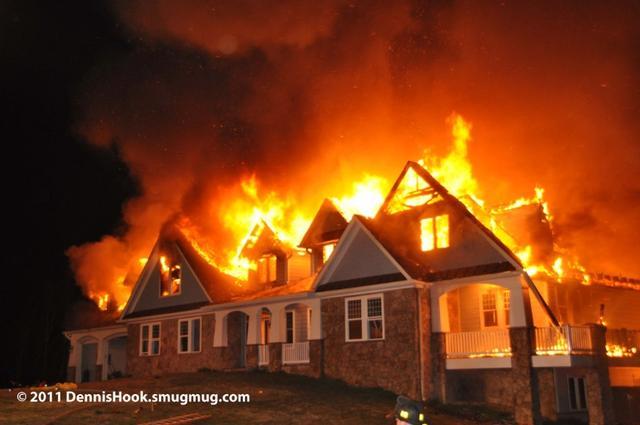
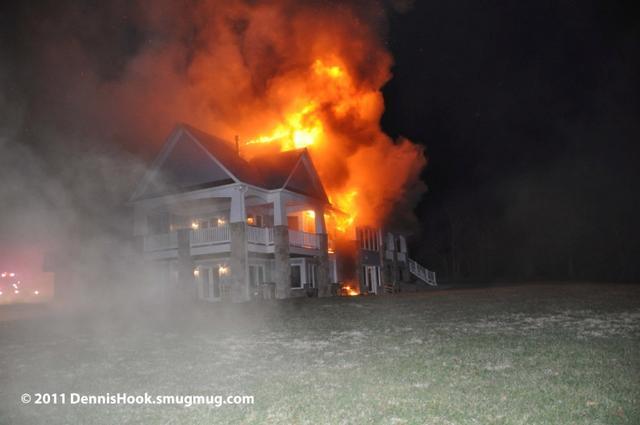
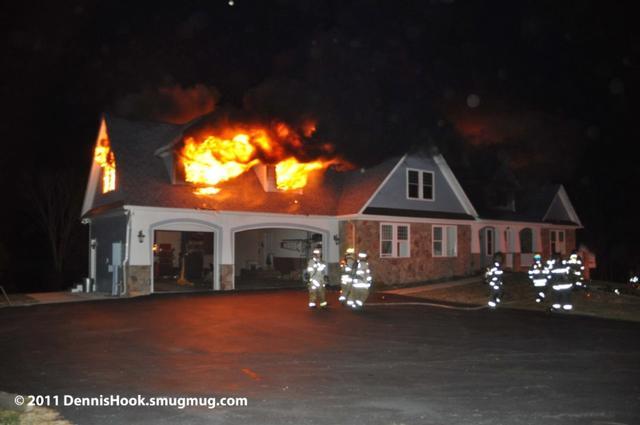
By: Chief William Goldfeder & Chief Jonathan Riffe This is the conclusion of a two-part report on operations at a March 19, 2011, house fire in Huntingtown, MD, at which 10 firefighters were injured, including four who received significant burns. Fire and rescue personnel from the Huntingtown Volunteer Fire Department (HVFD) responded along with other departments from throughout Calvert County and numerous mutual aid departments from Anne Arundel, Charles and Prince George's counties. As we reported in part one (September 2012), about 15 minutes after interior firefighting operations were begun, conditions on the second floor deteriorated rapidly as the main body of heavy fire in the attic and void spaces dropped down on firefighters. This forced an emergency evacuation of the second floor. Given the severity of the injuries and magnitude of the event, Chief William Goldfeder was asked by HVFD Chief Jonathan Riffe to assemble an independent investigative team to critically review the incident so others can learn about what happened there and how to prevent injuries in the future. The team consisted of Assistant Chief Donald W. Heinbuch of the Baltimore City, MD, Fire Department; Division Chief Michael W. Robinson of the Baltimore County, MD, Fire Department; Chief Jonathan R. Starling of the Sterling Volunteer Fire Department in Loudoun County, VA; Chief William Corrigan of the College Park Volunteer Fire Department in Prince George's County, MD; Captain Justin L. Green of the Loudoun County, VA, Department of Fire, Rescue and Emergency Management; and Deputy Chief William Goldfeder of the Loveland-Symmes Fire Department in Ohio, who was chairman of the investigative team. The team was assisted with logistics by James W. Richardson, coordinator, and Katie Hanko, both from the Fire-Rescue-EMS Division of the Calvert County Department of Public Safety. Particular thanks to Captain Justin Green, who served as the scribe and the architect of the document as the report was being developed. As we stated in part one, the investigative report contains the results of the team's comprehensive review and analysis. All of the information presented is factual and, to the greatest extent possible, was validated by multiple sources prior to inclusion in this document. It is important to note that the investigative team had months to examine the incident, form conclusions and develop recommendations. In contrast, the first personnel to arrive on the scene had only seconds to make critical decisions and take action. This column continues a synopsis of the investigative report. FIRST ARRIVING UNITS:
Engine 6-2, the first suppression unit to arrive on scene, reported, "6-2 laying out at the end of the driveway, gravel portion."
Chief 6C exited the vehicle and met the lieutenant, who had arrived before Chief 6C, at the rear of the vehicle where they both donned their personal protective equipment (PPE) and self-contained breathing apparatus (SCBA) carried in Chief 6C's vehicle. Once equipped, they both entered the home via the front door on side Alpha. Chief 6C entered the open door and traveled across the foyer where the stairs to the second floor were visible. Chief 6C reported seeing a haze on the first floor, while light smoke was visible at the ceiling level of the second floor when looking up the stairwell. The lieutenant remained in the foyer while Chief 6C accessed the two-story great room to the rear of the home where he found the fireplace. No fire or signs of fire were visible around the fireplace. On the way back toward the foyer, Chief 6C met an older occupant of the home who was carrying pictures from a den/office area. The occupant was instructed to exit and Chief 6C quickly checked the remainder of the first floor for occupants before returning to the foyer. Engine 6-2 arrived on scene with five personnel. After laying out from a position in the driveway where the surface changed from asphalt to gravel, Engine 6-2 laid approximately 800 feet of threeinch supply line. Chief 6C reported that the engine company also stretched a 400- foot, 1¾-inch pre connected attack line to the front door of the house. 00:09:36 – Chief 6C: "Alright, everybody's out the house, (Chief 6A). We're running the 400 right now."
Once the first floor was checked and no occupants were found, Chief 6C returned to the foyer and met with the lieutenant. As they were ascending the stairs to the second floor, Engine 6-2 arrived in the foyer. Engine 6-2 had stretched the 400-foot, 1¾-inch handline to the front door and proceeded, with the line dry, to the second floor. Upon entering the house, the crew reported there was no sign of smoke on the first floor. In the foyer, they found the stairwell to the second floor, which they ascended, and found light smoke at the ceiling level. Once at the top of the stairs, Chief 6C checked the side-Delta area of the second floor and the lieutenant turned to the left and moved toward side Bravo over the garage where there was a "bonus room" (a multi-purpose room often found over a garage or in an attic). Chief 6C returned briefly to the top of the stairs and told Engine 6-2 that they "couldn't find attic access and (they) would need to find a way in to the attic." Upon reaching the second floor, the unit supervisor of Engine 6-2 moved to the Bravo side of the house where the bonus room was over the garage. The intent was that firefighters were "going to go that way and work our way back." In the bonus room, firefighters used pike poles to open inspection holes in the ceiling looking for fire. They did not find any signs of fire and firefighters moved from the Alpha and Bravo quadrants, across the open area and toward a bedroom on side Delta. At this point, the hoseline had still not been charged. 00:10:27 – Chief 6C: "Operations to Command."
At this point, a large number of firefighters were in the open area with most of them working to find the fire by hooking the ceiling. Several firefighters reported that there was little coordination or direction beyond "bring long hooks" and "hook the ceiling." Units generally stayed together, but eventually spread around the open area. At this stage, numerous personnel were operating inside in an attempt to pull ceilings, find the best access to fire and attack. THE FIRE EMERGENCY:
Huntingtown Command reported seeing a flash of light across the large window in the second-floor open foyer concurrent with a rapid increase in fire and smoke issuing from the second floor. On the interior, firefighters operating in the bedroom and firefighters operating in the second-floor open area reported rapidly changing smoke conditions followed by a sudden spike in temperatures that quickly changed to fire progressing from the ceiling level to the floor (see Photo 2). Chief 6C, at this time positioned in the foyer area assisting with hoseline advancement, observed a rapid increase in smoke visible up the stairwell and then fire in the two-story great room. Chief 6C reported fire was visible to the approximate level of the first-floor ceiling in the great room. Chief 5B, positioned in the great room near the first-floor fireplace, saw fire progress down the stairway and "blow out the front door." On the exterior, Huntingtown Command recognized these conditions and called for an evacuation. In the second-floor bedroom, the officer from Engine 6-2 became separated from his firefighter on the nozzle and ultimately jumped from the second-floor window, landing on the first-floor overhang before landing on the grassy surface on side Alpha. The firefighter from Engine 6-2 and a firefighter from Squad 6 operating in the bedroom retreated to the stairway. Multiple firefighters operating in the open area on the second floor reacted to the rapid fire progress by immediately implementing survival techniques. Firefighters partnered up with other firefighters by holding onto airpacks and rapidly descended the stairs. At least one firefighter found the hoseline and followed it until the banister surrounding the stairwell was located. Several firefighters, upon locating the banister, jumped or fell to the first floor. Chief 2, operating as Division 2, on the second floor encountered a rapid heat buildup while standing next to the railing around the stairwell. Chief 2 sounded his PASS (audible warning device) to serve as a beacon for other firefighters on the second floor before following the hose down the stairs. Once in the foyer area, Chief 2 helped pull down hoselines from the second floor and gather equipment. When Chief 2 discovered a helmet from a Company 2 firefighter, Chief 2 conducted a face-to-face accountability check with Engine 2-1 and Tower 2 before confirming all personnel from Company 2 were accounted for with Huntingtown Command. EMERGENCY TRANSMISSIONS:
Medic 102 had requested aero medical evacuation resources in the form of helicopters from Maryland State Police as soon as firefighters appeared in the doorway evacuating the house. Huntingtown Command: "Please somebody get on the handlines."
After no success, Engine 6-2's driver/operator is asked, "Who was on your fire truck?" There was no recorded response and there is no further mention on TAC 1 regarding accountability of firefighters or EMS resources. The remainder of the radio traffic concerns logistics and suppression efforts to combat the remaining fire. Accountability of Engine 6-2 was accomplished through face-to-face communications.
LESSONS LEARNED AND RECOMMENDATIONS:
PRE-INCIDENT INFORMATION:
DISPATCHING AND RESOURCE ALLOCATION:
Simply put, when there is a verbal report of a building fire to a dispatcher, the department should send what may be needed (what matches that type of building and life risk) with the assumption that it will be a fire, before it has to be confirmed by arriving units. This fire did not have a response plan that matched the potential fire risks or the conditions that the firefighters encountered upon arrival. INITIAL ON-SCENE ACTIONS:
We cannot emphasize enough the critical importance of establishing command by the first-arriving officer and communicating (and leading) the strategy to responding or on-scene units. An initial radio report should include relevant information (fire/life conditions, actions, needs, etc.), a strategy statement and direction so that units and personnel understand what they are to do and what they are not to do. It is also important that all Calvert County companies/departments follow the same procedure for initial actions as the volunteer departments, to their credit, operate as one countywide fire system when responding. Responding units to this fire did not have a clear understanding of the fire conditions and the tactical strategies. INCIDENT COMMAND AND ACCOUNTABILITY:
The county does have a volunteer "duty officer" response plan that sends an extra chief on building fires, but it is based on availability and does not ensure the response of other chiefs to ensure adequate command leadership and support. This fire did not have an adequate number of responding command-level support officers to assist the incident commander. WATER SUPPLY:
One solution is to require fire sprinkler systems in all future built structures. However, since buildings already exist in numerous non-hydrant areas in Calvert County, we recommended that they seek out a subject matter expert to be contracted to conduct a rural water supply evaluation and develop a plan in cooperation with county departments and companies. The plan should include a requirement to analyze the current resources, develop training for Calvert County firefighters in rural water supply, implement upgrades to all apparatus supply hose to LDH and the development of additional rural water supply sites. This fire did not have an adequate water supply. COMMON POLICIES AND PROCEDURES:
In some cases where firefighters also work or serve in other jurisdictions, learned strategies, tactics and procedures from that jurisdiction may conflict with what is appropriate for operations in Calvert County. In so many areas of the U.S. and Canada, fire departments now run a lot more mutual aid as well as automatic mutual aid. In that case, common policies and procedures are essential to increase the chances of success on the fireground. This fire demonstrated the need for all companies and departments to have common policies and procedures that are trained on and enforced with mutual agreement. CONCLUSION:
|
|
|
|
||
|
|||